
How Cases Proceed through the IL Courts
Illinois has had a unified court system since 1964. In that year, voters approved an amendment to the 1870 Constitution which made major changes in the system. Prior to 1964, the court system was fragmented. The courts of original jurisdiction had some concurrent and overlapping jurisdiction, and each court operated independently of the others.
The old system had a circuit court with statewide original jurisdiction in all cases and some appellate jurisdiction; a Superior Court of Cook County having concurrent jurisdiction with the Circuit Court of Cook County; the Criminal Court of Cook County also having concurrent jurisdiction with the Circuit Court of Cook County but limited to criminal cases; a county court in each county with special jurisdiction that partially overlapped that of the circuit court; a probate court in certain counties with special jurisdiction; statutory municipal, city, town and village courts, with jurisdiction overlapping that of the circuit court; and justice of the peace and police magistrate courts with limited jurisdiction.
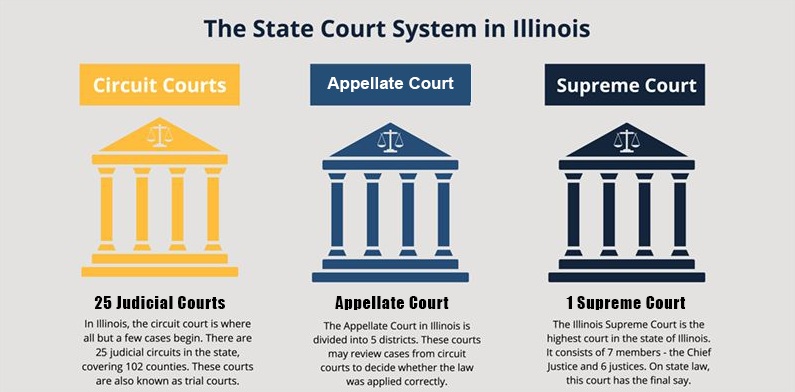
In today’s system, as shown below, there are three levels of courts: circuit, appellate, and supreme, all operating within clearly defined geographical boundaries. The circuit court is a court of original jurisdiction which is divided into twenty-five circuits. Each circuit is located in one of five appellate court districts. Cases enter the circuit court via the circuit clerk’s office in a county of the circuit. Cases may be appealed to the appellate court in the district containing the circuit court, or, in certain circumstances, directly to the Supreme Court. After an appellate court decision, parties to the case may seek discretionary review by the Supreme Court.
Three Levels of Courts in Illinois

In Illinois, the circuit court is the court of original jurisdiction. There are twenty-five judicial circuits in the state. Seven are single county circuits
(Cook, DuPage, Kane, Lake, McHenry, St. Clair and Will) and the remaining eighteen circuits comprise as few as two and as many as twelve counties each.
Map of Illinois Judicial Circuits

Except for redistricting of the general assembly and ruling on the ability of the governor to serve or resume office, the circuit court has jurisdiction for all matters properly brought before it. The circuit court shares jurisdiction with the Supreme Court to hear cases relating to revenue, mandamus, prohibition, and habeas corpus. If the Supreme Court chooses to exercise its authority in a case of these types, the circuit court loses jurisdiction. The circuit court is also the reviewing court for certain state agency administrative orders.
Types of Judges in the Circuit Court
There are two types of judges in the circuit court: circuit judges and associate judges. Circuit judges are elected for a six-year term and may be retained by voters for additional six-year terms. They can hear any circuit court case. Circuit judges are initially elected either circuit-wide, from the county where they reside or from a subcircuit within a circuit, depending on the type of vacancy they are filling. Associate judges are appointed by circuit judges of that circuit, pursuant to Supreme Court Rule 39, for four-year terms. An associate judge can hear any matters deemed suitable by the chief judge or designated circuit judge.
Circuit judges in a circuit elect one of their members to serve as chief circuit court judge. The chief circuit judge has general administrative authority in the circuit, subject to the overall administrative authority of the Supreme Court. The chief judge can assign cases to general or specialized divisions within the circuit.
Difference Between Bench & Jury Trial
The main difference between a bench trial and a jury trial is who decides the outcome: a single judge or a group of everyday citizens. In a bench trial, the judge rules on the law and decides the final verdict. In a jury trial, a panel of jurors decides the facts and guilt or liability, while the judge manages the legal rules.
In Illinois, equity/chancery cases, juvenile proceedings, and civil claims seeking non-monetary relief do not have an automatic right to a jury trial. This would include matters like divorce, mortgage foreclosures and probate. Instead, these cases are decided by a judge in a bench trial.
- Bench trial: The judge acts as both the referee of the law and the finder of fact. There is no jury present.
- Jury trial: A panel of jurors (usually 6 or 12 citizens depending on the case type) listens to the evidence and must reach a verdict. In Illinois criminal cases, a jury verdict must be unanimous.
